
Weekly cleaning routine: how to plan it day by day
How to spread house cleaning across the week, what to do every day and what to leave for once a month, with a sample schedule you can copy.
A lot of people clean the whole house on Saturday morning: three or four hours straight, all at once. It works for a while, until one Saturday you have plans and the next week there’s twice as much to do. A weekly routine splits that work into half-hour blocks during the week, so no day feels heavy and your weekend stays free.
Here’s how to set one up step by step, with a sample schedule for an average home and what to do when you miss a day.
Step 1: separate daily chores from weekly ones
Before you split anything, sort your chores into three groups.
Every day. The things that get dirty with use and pile up fast if you leave them: washing the dishes or loading the dishwasher, wiping the counters after cooking, making the bed, tidying the living room at night and taking out the trash. None of them takes more than ten or fifteen minutes.
Every week. The full bathroom (toilet, sink, shower and floor), vacuuming and mopping floors, dusting, changing sheets and towels, cleaning the kitchen sink and checking the fridge.
Every month. What you don’t see every day but notice when it’s forgotten: the oven, the inside of the fridge, the range hood filter, windows, tile grout or the closet.
Daily chores stay out of the weekly split. If you try to put “wash the dishes” on Tuesday, by Wednesday you’ll have two days’ worth in the sink. Daily chores are a habit; the weekly routine is for everything else.
Step 2: pick the days you actually have
You don’t need to clean seven days a week. Most people pick three to five. Look at your real week: if you get home late on Mondays, leave Monday out. If you have Wednesday evenings free, that day can carry more.
With five days, a home with a kitchen, bathroom, bedroom, living room and entryway comes to about 35 to 50 minutes a day, depending on how thorough you want to be. With three days, each one runs a bit over an hour. Both work; what matters is that what you put on each day fits the time you have.
Step 3: group by room
It’s faster to clean the whole bathroom in one go than to do the toilet on Monday and the shower on Thursday. You get the products out once, work top to bottom, and when you’re done the room is finished.
The practical rule: one or two rooms per day, with the heaviest one (usually the bathroom or the kitchen) on the day you have the most time.
A sample weekly cleaning routine
This routine is for an apartment with a kitchen, one bathroom, a bedroom, a living room and an entryway, with five cleaning days. Times are approximate.
| Day | What’s due | Time |
|---|---|---|
| Monday | Full bathroom: toilet, sink and mirror, shower, floor and towels | 45 min |
| Tuesday | Kitchen: sink, floor, microwave and fridge check | 35 min |
| Wednesday | Living room: dust, vacuum floor and rug, mop | 40 min |
| Thursday | Bedroom: change sheets, dust and vacuum. Laundry | 45 min |
| Friday | Entryway and catch-up: shoes, doormat, water plants. Fold laundry | 30 min |
| Saturday and Sunday | Free. Daily chores only | — |
And every day, no exceptions: dishes, counters, bed, tidy the living room and trash.
Monthly chores are spread over the four weeks of the month so they don’t land together. For example: the oven in week one, the inside of the fridge in week two, windows in week three and bathroom grout in week four. Each one goes on the lightest day of that week.
If you want this same schedule with your rooms and your days, the weekly cleaning schedule builds it instantly: check what you have, pick a cleaning style and your days, and it does the split for you, for one week, two weeks or the whole month. You can edit it and download it as a PDF for the fridge.
Light, standard or deep
Not every week is the same, and not every home needs the same amount of cleaning. It helps to have three levels in mind.
Light. The basics so things don’t get out of hand: daily chores, bathroom, floors and sheets. It’s the level for busy weeks, for getting started or for small apartments.
Standard. Adds the microwave, the fridge, mopping as well as vacuuming, the couch and the kitchen cabinet fronts. It’s what makes a home feel looked after without living to clean.
Deep. Adds the monthly chores: oven, range hood, tiles, windows, mattress and closets.
You can move between levels. A light routine you stick to every week keeps a home cleaner than a deep one you drop by week three.
What to do when you miss a day
It will happen. A busy week at work, a sick kid or just a Tuesday when you can’t face it. What breaks a routine isn’t skipping a day, it’s trying to catch up on everything the next day and ending up with a two-hour Wednesday.
Three simple rules:
- Move it, don’t stack it. If you didn’t do the bathroom on Monday, move it to the next day with the lightest load instead of adding it to Tuesday.
- Daily chores, always. Even if you skip the day’s block, do the dishes and make the bed. They’re what stops a home from getting really messy.
- A bad week isn’t a broken routine. Next Monday, start where the schedule says, without trying to make up everything from last week.
Make it stick
A routine lasts when you don’t have to think about it. A few things that help:
- Keep it in sight. Printed on the fridge or on your phone, somewhere you see it without looking for it.
- Keep products together. One caddy for the bathroom and one for the kitchen saves trips and excuses.
- Use a timer. Set 30 minutes and stop when it rings, even if something’s left. Knowing there’s an end makes it easier to start.
- Review after a month. After four weeks you’ll know which chore always gets skipped and which day has too much or too little. Adjust and keep going.
If you share your home, the routine needs to be shared too. In how to split household chores we explain how to do it by time rather than by number of chores.
The routine on your phone
A paper schedule works, but it doesn’t remind you or adjust when a day changes. Tidily does the same thing on your iPhone: when you start, you choose your rooms, your cleaning style (light, standard or deep), the days you’re free and how many chores you want per day, and the app builds your plan and spreads it across the week.
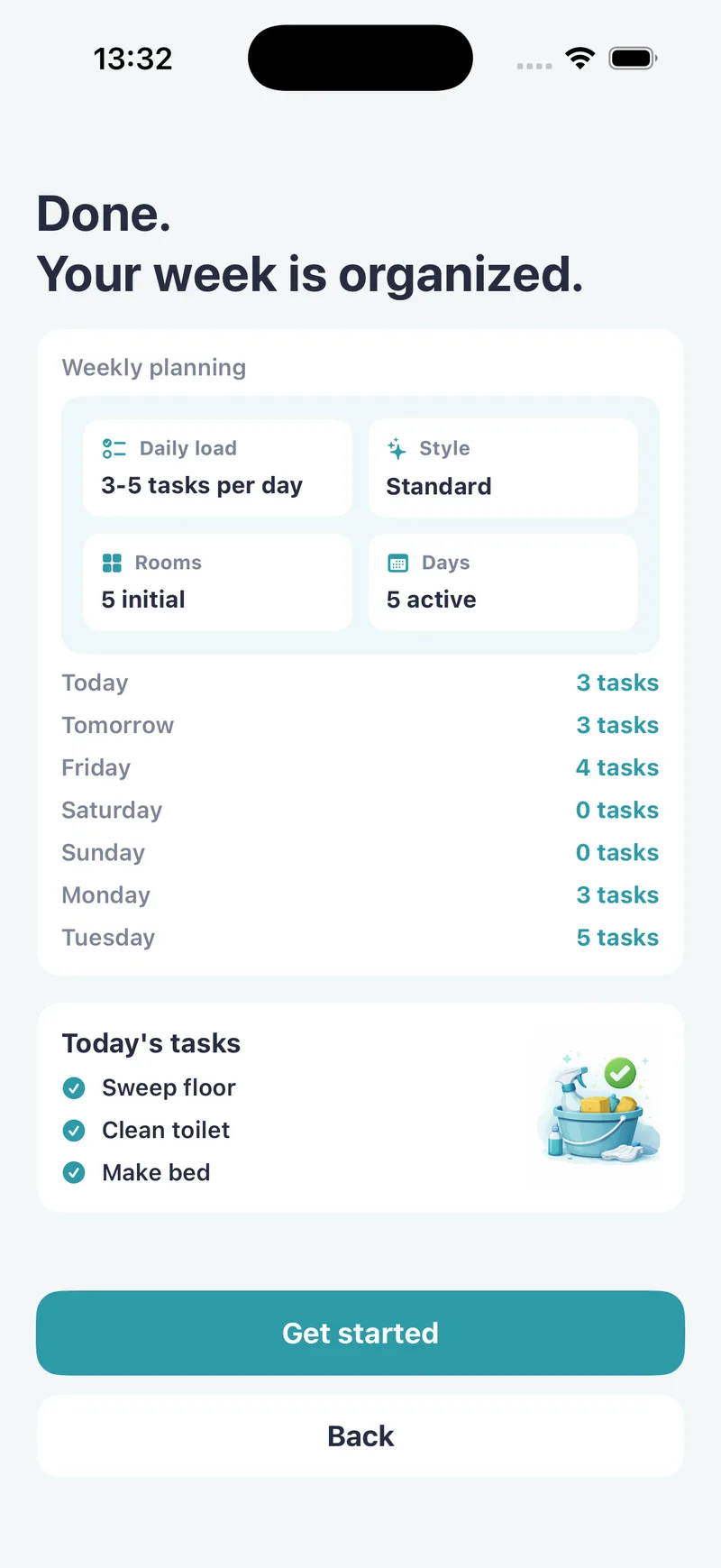
Each day you open the Today view and see only what’s due, grouped by room. If you miss a day, the task stays pending until you do it or move it to another day, without stacking up repeats. And you can turn on a reminder at whatever time you like.
For a home with more rooms or different chores, the room-by-room cleaning checklist has every chore for each area, sorted by frequency.
Frequently asked questions
How much time should I spend cleaning each week?
In an apartment with a kitchen, one bathroom, a bedroom and a living room, about three to four hours a week spread over several days, plus 30 to 40 minutes a day of dishes, kitchen and tidying. With more rooms or more people at home, a bit more.
Is it better to clean a little every day or all at once on the weekend?
A little each day is less tiring and keeps the house cleaner all week. Cleaning everything on Saturday works if you truly have those hours free every week.
Where do I start if the house is a mess?
With decluttering before cleaning. Spend the first few days just putting things away and clearing surfaces. With the house tidy, the weekly routine goes much faster.
What products do I need?
Not many: an all-purpose cleaner, a bathroom cleaner, dish soap, glass cleaner, microfiber cloths, a broom or vacuum and a mop. Always follow the label directions and never mix products, especially bleach with ammonia or other cleaners.